

At a regional office of a large automotive company, I was leading a Data & Analytics team — data analysts, engineers, and product owners. We were busy. Too busy. And yet… it didn’t always feel like we were making the progress we wanted.
There were bugs to fix, people to help, ad-hoc tasks to do — the kind of daily noise that makes a team feel productive, but also scattered. Priorities were blurry, and while effort was high, delivery and visibility on what we were actually delivering was not. Plus, we had many stakeholders to manage, all with different requests, expectations, and levels of urgency.
That’s when I decided to try something our department hadn’t done before: implement OKRs.

A quick note on OKRs
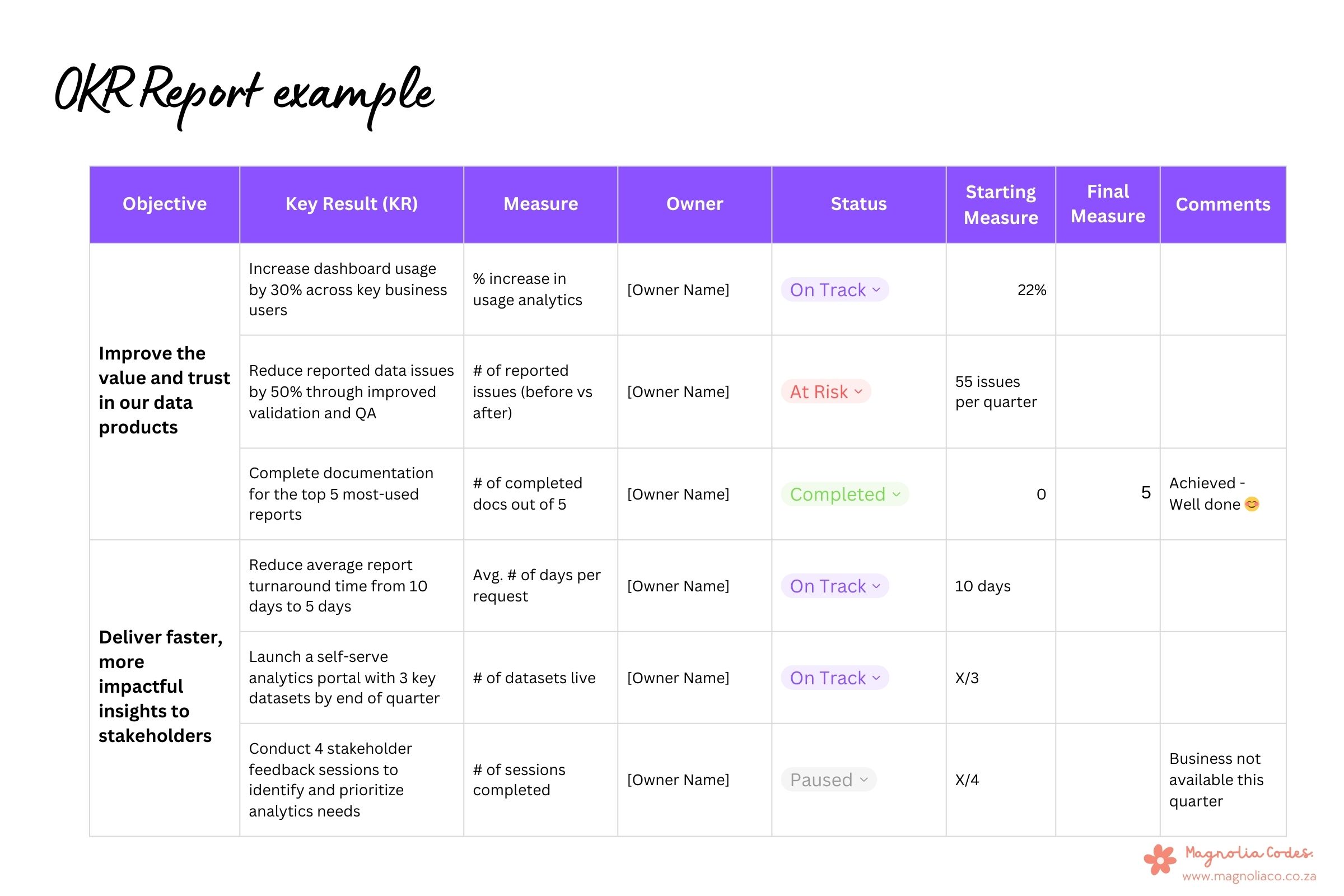
OKRs — Objectives and Key Results — are a goal-setting framework made famous by Intel, and later adopted by Google. The idea is simple: define ambitious objectives, then set 2–5 measurable outcomes (key results) that track progress toward them. It’s a powerful way to focus a team’s energy, create alignment, and measure what matters.
How we started
Some teams in the company were already using OKRs, but this was a first for us. I ran a two-hour workshop to introduce the concept — what OKRs are, why they matter, and how we could make them work for us.
After that, we co-created our first round of team OKRs. Then, in pairs, the team defined their own — aligned to the bigger picture but shaped by their individual responsibilities. We regrouped in another workshop to review and finalise everything.
It was a lot of upfront effort. People were already overwhelmed, and now I was asking them to spend hours in a room talking about “goals”? There was resistance. I get it. But we pushed through.
The payoff
By the end of the quarter, something surprising happened: in our review, we realized just how much we’d actually achieved. We ticked off key results. We saw progress. We had proof of focus. It turns out we have short memories when we’re busy — it’s easy to forget all the work we have done while stressing over what’s still on our plate.
That review wasn’t just a checkbox exercise — it was a moment to celebrate the wins, reflect, and reset with clearer eyes.

How we made OKRs work in a real team
We captured our OKRs in Confluence, and later connected them to our epics and tasks in Jira so the work stayed visible and trackable. We started by setting team-level OKRs, with a clear owner for each. That owner wasn’t necessarily the one doing the work, but they were responsible for driving progress and follow-up.
We grouped our OKRs into three focus areas:
-
Reports/Projects
-
Data Modeling
-
Tech-Debt (our internal improvements and housekeeping)
We did a short bi-weekly review to stay on track, and a more in-depth session at the end of the quarter. During daily standups, I would often ask, “Which OKR does that link to?” This helped connect day-to-day tasks back to the bigger picture — and encouraged more intentional prioritization.
Example OKR
Objective: Improve data quality across key dashboards
Key Result 1: Reduce data refresh errors by 80%
Key Result 2: Automate 3 high-maintenance manual reports
Key Result 3: Complete data dictionary for top 10 dashboards

If you’re thinking of trying OKRs…
Here’s what I’d tell any team lead:
-
Push through the first cycle. It’s messy, time-consuming, and a little uncomfortable. But it gets faster and easier with each round.
-
Don’t aim for perfection. Build a version of OKRs that works for your team. Offer guidance, but let them shape the details. It needs to be useful, not just a pretty slide for management.
-
Focus on what the team can control or influence. There will always be delays from dependency systems, unavailable stakeholders, or shifting priorities from management. Your role is to protect the team’s focus and help them succeed despite these — OKRs should reflect the areas where the team has real ownership.
In Summary
As a leader, I saw how easy it is for good teams to get swept up in the small stuff — fixing bugs, responding to requests — and forget to protect time for the big strategic work. OKRs gave us a way to step back, realign, and measure what really matters.
OKRs didn’t just help us plan better. They helped us see better — what mattered, what we’d accomplished, and what we needed to focus on next. If you’re feeling stuck in the noise — try it. You might be surprised at what your team is actually capable of.
Use the link below to get my FREE Canva OKR template.